Ah, fuck this show. Seriously, it can just fuck off. I was thinking when I finished Vandread that I would feel very much the same about Kiddy Grade. But thanks, as I expressed earlier on my (plug plug) twitter, the Cover By Cover review/riff of Kiddy Grade made me be perfectly honest with myself. This show is garbage.
I've never been honest with myself because three of my best friends, the orchestrators of the list which I am only today (having started in Feb/March) concluding, list it among their favourite. I don't know whether to blame nostalgia or contrasting tastes, but I've kept my distaste moderate around them.
Cover By Cover do a damn good job ripping what turn out to be serious problems with the entire run of the show: the overpowered state of the stars, the horrible, horrible blatant fanservice of REALLY FUCKING YOUNG KIDS, and the lack of plot for the majority of the show.
What they fail to note is just how shit this show is, even when the "plot" starts roaring.
I just bloody can't take this show a character at a time like I prefer to do, so let's just jump into the bullshit.
Plot:
Eclair (or, as CBC refer to her, "Panty") and Lumiere are agents in the not-UN/EU/World Bank. They deliver things and hurt people in flashy way. Then events occur. I'm not overly eager to spoil this show, because that's more effort than it's worth, but I'll have to just for things to say.
Basically there's dissent in a planet that the women are called in to put down. they side with the workers who they are told to help brutally suppress. They become outlaws from the giant international conspiracy of aristocrats who are trying to kill them. Them there's a coup in the not-UN, and clones, and a human-shaped death star and someone is related to Eclair, and then Eclair is born.
Yeah. The plot isn't that important, so I'll address it first: it's crap.
It's full of elaborate conspiracies and historical homages, but it never runs with them. It doesn't know what it's trying to say. OK, so this planet is having a revolution, and you're on the wrong side of it. So why do you change your mind? Do you consider the consequences? What is the long term goal of the people? And, most importantly, in the grand conspiracy, why does this matter at all? I'm not saying all these questions aren't answered, but they aren't expanded much at all over the course of the show.
Another example is the conspiracy itself, where a bunch of rich aristocrats attempt to control the universe, while living comfortably on Earth, and plan to fuck everyone over and leg it. Fine. But explain it. How did this start? Some individual examples of planets in which families were forced to sign away their lives, and that of all their descendants, to live on colonised planets owned by the aristocrats. That's alright, but doesn't explain how this didn't happen everywhere, and yet this network emerged. And why is it aristocrats? When did this colonisation start? I mean, sure, there's an obvious upper class in modern societies (everyone loves Capitalism - best equality ever), but they aren't traditional aristocrats. There isn't a focus on class, behaviour and blood as much as ability, wealth and ability. Simple things like clothing and culture are just not realistic for a society descended from ours.
I'll boil this all down to one question: What is this show trying to say?
Are the aristocrats meant to be modern capitalists? Is this an appeal to Socialism, or an alternate economy which rejects the idea of classes? Or is it a reflection of the inevitability of human behaviour, the inherent appearance of a ruling class who abuses their power? Is it attempting to argue that the universe is undergoing a form of Marxist revolution, in which this group is overthrown, or is it anti-Marxist, saying you'll never be rid of this group?
Even if the show outright stated this in a concise and intelligent way, instead of the confused and tangled mess it actually provides, I wouldn't be really impressed. The constant fanservice and pathetic characterisation undermine any attempt to convey a purpose.
I need to be clear: not all Anime need to state their purpose, after-school special style, aside from the story. It doesn't have to be clear or obvious, but it really needs to be there. I mean, the main characters work for a major UN style organisation. Does it fail because it's inherently flawed to attempt to maintain a status-quo? Or is it a fine idea, simply undermined by those abusing the function of the service? You simply CANNOT attempt to bring all of these elaborate ideas and organisations into the story and say nothing about their operational function and potential. It's the same reason constant pop-culture references get old quickly. If there isn't a purpose, it is quite literally pointless.
Vandread spelt itself out upfront: gender is not the most important way in which humanity should divide itself. Behaviour, personality and morality are much more important than something as petty as gender.
Is it well conveyed? No. Does the nature of the show somewhat undermine the message? Yes, a little. Does it take a little searching to find it? Yes. There's also probably more the show is trying to say, but this is my takeaway, which I agree with (which helps), and I respect it.
Angel Beats: Life is important. Youth is important. People are important. Treasure all of them.
Much better conveyed and much more to the point, and reinforced by the very nature of the show. This idea of a message is not simply restricted to anime which take themselves seriously.
Hayate no Gotoku: Don't be anti-social and an introvert. Go out and live life.
This is hardly subtle, and is constant. The show plays with it, with Nagi always fighting those who want her to be social and defending her position as inevitable, but the show does glorify human interaction, despite being an indoor medium. I don't quite agree with this message, but I have to admit it's there.
Kamen no Maid Guy: What people want is more important than what you think they need. When they express what they want, give it your all.
Reinforced by the nature of the show and the interaction between the main characters, although some of the smaller plots slightly clash.
Sorry for going off on a tangent, and not drawing out particularly academic messages, but these are pretty clear. Kiddy Grade just constantly quashes any attempt at a reliable message. Is authority inherently good (as implied in the first few episodes)? Is it inherently bad (as conveyed in the middle episodes)? Is SOME authority good? It's only with the power of the GOTT (the not-UN) that the main characters defeat the Aristocratic death-star. What am I meant to walk away from this show thinking? I might be under or over-thinking it, but I feel this is part of my problem with the entire show. Other than the last episode, which is literally nonsense for the most part to me, it generally lacks focus.
The show goes between distinct arcs, with the women working for, then against, and then for the GOTT again. It lacks any real development of the story at large. There is, as an aside, a fuckload of 9/11 imagery in the attack on GOTT HQ. There is, in regards to tone, nothing worse than an anime that uses powerful imagery to say nothing. I seriously would rather the show argue that Al Qaeda was completely justified in the attacks, as that would be interesting and would spark discussion. Using this imagery for no purpose silences any discussion of the show and its deeper meaning, as much as I'm trying. All the self-contained, episode long plots, which eventually added up to nothing, are particularly guilty of this. I'm perfectly aware that I often attribute unintentional historical and political significance to anime (we'll get to why both L & Kira were fascists in Death Note), but I refuse to accept all, or even any, of this was accidental. Episode 1: a moderate diplomat employs a third party military in order to bypass his own overzealous and politically independent military.
Just take America in Iraq, Japan in China, America in Nicaragua, The Falklands, or so, so, so many real life examples of this. It hits too close to reality to be accidental. It is attempting to throw historically significant shit at the meaning wall to see what sticks - except the wall is made of shit.
As that aside points out, the story doesn't do anything. I don't know how the show ends (I mean, I saw it, I just don't understand it), so I can't say if it chronologically just ends at the beginning, but in regards to tone, character development and message, it already did. The characters pulled off an act of reasonable heroics. Fin. Nothing learned.
I've been talking about message and tone too long. Let's just pretend this is porn, where they forgot to take (what little was left of) the clothes off the cast. No message more important than "enjoy yourself". What's left? There isn't characters. I just outright refuse to accept that. These characters are paper thin and completely pointless. Yes, I believe all of them are completely pointless, even the main women. I mean, if the show has no point, why would the characters? Other than this, there is no personality in anyone other than "brash", "smart" and "smug". I don't care enough to talk about them more, but they are probably the weakest part of the show, and that's saying quite a lot. My response to "Who is my favourite character?" is not "Nobody" but "Characters? What characters?".
I don't want to dwell on meaning or tone for much longer, but I am honestly hunting for something else to talk about. As I said on twitter, this show is absolutely awful, but in the most boring ways. I guess the horrid fanservice is worth mentioning, even as an aside.
It's utterly pointless. Actually, no, that's wrong. It's the ENTIRE point. That is why this show exists. Because breasts. And arse. And 10 year old girls in swimsuits. OK, I normally use the exceptionally euphemistic phrase "Lolita" to handwave the sexualisation of underage girls. But this is outright paedophilia. I mean, if this is your thing, go for it, better anime than reality, but for fucks sake. Why is this in an anime that anyone I know likes? This is just foul, and not even just the 10 year old. I mean, let's admit that the attire of these women undermines their position as law enforcers or military-trained peacekeepers. If real women wanted to dress like this? Fine. More power to them. Have fun, and I hope it's comfortable on every level. In an anime made by/for straight men? Fuck. Off. This is just pathetic. I have no problem with something existing for just titillation, although I don't get the parts that AREN'T for arousal, and I somewhat feel what is essentially porn shouldn't invoke 9/11 imagery for...well, any reason.
I just don't get the reason this show exists. Sure, it has a lot of T&A, but if it wanted to, it could easily have added much more. So why didn't they? Was there a reason? There isn't an arc, there isn't a story, there isn't a moral, there isn't a tonal essence, there isn't a message, there isn't an emotional significance, there isn't a justified historical homage, it doesn't provide another perspective on any of the multitude of issues it clumsily touches upon like a bowling ball into a Jenga tower, it doesn't have a reason to exist and I sure as fucking hell never want to watch it again for any reason I can possibly think of. I just despise this show.
Let me wrap up. For once, I can't use the rather generic phrase "This show failed at what it was trying to achieve, but I respect what it was going for." Sure, it's often relevant, and I feel like I use some version of it or another every review, and I'm not saying it's incorrect in those contexts. Here I feel something utterly different. I despise this show because it didn't know what it was going for. It was a high-schooler attempting to emulate academic writing styles they saw online. It only saw the end product, and that people liked it. It didn't understand what the act implied or required. Perhaps a more fitting comparison is Kiddy Grade's constant historical and political homages are more akin to a child using a horribly racist slur. Someone important used it, so it has significance, and people reacted to it.
This show is just horribly confused. It doesn't know what it wants. Hell, I'm not saying I know what I want it to be either. I just wish it had been planned out so much more than it was. It's shows like this than make me so averse to sci-fi in general, because so often it is just the product of someone who couldn't be bothered working out how our world works, so they just wanted an empty canvas to project these same confused and jumbled ideas onto, but in space.
Just...don't watch this show, 'K? Or if you do, tell me what the fuck that ending was about. Because I've got no bloody idea. Anyway, I'm not going to talk about the next anime on my list, Armitage III. Although it is interesting, particularly arguing if the message was ultimately pro- or anti-feminist, it was just too short for me to really say that much about. Instead, we'll be skipping to one of the most unique animes I've ever seen - Needless. May the reviewing Gods give me strength.
Thanks for reading,
H. Rourke.
Wednesday, 29 October 2014


Tuesday, 28 October 2014
Whitlam - Part 2
Whitlam was elected into power in 1972. He was in power for three years, and changed the face of this nation forever. I'm not even going to try and address these three glorious years chronologically, because there really is no need to.
Let's run through the big changes, one at a time, in some attempt to cover the basics.
1. Indigenous Rights:
In 1966, the Gurindji people in the Northern Territory had led a walk-off from Wave Hill Station, owned by a British company called Vesteys. They camped at at Wattie Creek and protested their living and working conditions under the British. What happens next is known by every Australian, more than what happens when a jumbuck meets a swagman, or how we toil under a Southern Cross. Like many parts of Australian history, this affair has been saved in song. Specifically this one:
For context, Indigenous Australians hadn't had a guaranteed vote in all states until 1962. This was an absolute political avalanche of reform that hadn't been dreamt of in the 1967 Referendum regarding the acknowledgement of Indigenous Australians. There is so much more to say on the legacy of Whitlam in this field, but this is not meant to be a thesis, or even an essay, so much as an overview for the curious.
2. Multiculturalism
Prior to Whitlam, it must be admitted that the White Australia Policy, attempting to prevent non-European immigration to the island, was already being dismantled. But the final death-knell of the horrid ideal was under the Whitlam administration, finally guaranteeing the ability for non-Europeans to immigrate to this country.
That wasn't all Whitlam did, however. For the next part, we have to turn to one of the many colourful characters who made up the Whitlam government. This is the Minister for Immigration: Al Grassby.
 |
| The ties never got better than this. Image info here. |
Grassby's legacy is speckled by his alleged criminal connections, but this is a distraction and a joke. He achieved great things, and his life should not be discarded as corrupt due to this simple allegation.
3. Women
Whitlam was a massive force for the enforcement of equal pay on gender lines, and made access to contraceptives easier. He also introduced the Single-Mother's Pension, which kept my sisters alive and out of orphanages during the massively anti-single mother zealotry my mother dealt with during the 1970s. Australia has a long history of proud Feminism, being the second country in the world to introduce suffrage. Whitlam managed to introduce another world first, which leads to the introduction of another member of the Whitlam government: Elizabeth Reid.
 |
| The name of this picture is "A Revolutionary in a Reformer's job". Hell of a title. Image info here. |
4. States & Territories
Whitlam was able to pull the states of Australia into the 20th Century, and allow those that were able to to move even further forward. Territories (Northern Australia and my own beloved Australian Capital Territory) were given more voting power, and voting districts were evened out. Let's look at two individuals who really demonstrate the reform of the period, for the worse and for the better. Let's start with the worst: Joh Bjelke-Petersen.
 | |||
| More informative than a mere portrait would be. Cartoon source here. |
Whitlam managed to introduce a policy that actually enforced democracy that didn't favour Bjelke-Petersen, and although Petersen managed to outlast Whitlam in politics, it was an important act of defiance. Whitlam also managed to pass the Racial Discrimination Act, which undermined Bjelke-Petersen after he tried and failed to have it thrown out.
There were of course progressive Premiers as well, who supported Whitlam, the most notable of which is Don Dunstan.
 |
| Dunstan is the one that isn't Whitlam (i.e. the right). Image info here. |
Dunstan was also responsible for changing the culture of SA, attempting to recreate a society that was far less British than previously. After his wife died, and he himself became horribly ill, he was forced to retire, but still managed to outlive Whitlam's political career.
Dunstan is important to understand the culture that Whitlam rode into power on. Dunstan came before Whitlam, and was more progressive, but realistically this was necessary. How could a left-wing PM come to power if there weren't similarly minded Premiers. Really Dunstan was just a hell of a guy, and considering one of my professors is writing a book on him right now, I felt I had to include him for the hell of it.
5. Vietnam
Whitlam has done so very much more than I can say, and this will be my final point, because I'm running out of steam and want this to get done. Vietnam was the most divisive period in Australia in the latter half of the 20th Century, bar perhaps the Red Scare, although the two were related. By the time Whitlam came to power, there was little to no support for the Vietnam War or conscription. The final character who is central to this is Dr. Jim Cairns.
 |
| Holy shit, colour! Image info here. |
Whitlam himself appealed to the young voter. He lowered the voting age to 18, from 21. He also ended conscription, freed those who had burnt their draft notices and brought back the Australian troops in Vietnam, ending the Australian involvement in Vietnam. He also, as an aside, gave independence to Papua New Guinea, a former Australian colony, really improving Australian relations with SE Asia.
OK, that's it. 3 goddamn years people. All of this, bar Dunstan & Bjelke-Petersen, happened between Whitlam's election in 1972 and his unceremonious dismissal in 1975. I wish I had a hope of hell of doing ANYTHING Whitlam managed in his time in power in my entire life, let alone under a decade.
I also have to admit I'm, like any academic or journalist (of which I'm neither), wildly biased. I have The Spanish in Australia by Al Grassby, The Quiet Revolution by Dr. Jim Cairns and The Dismissal: The Dramatic Fall of Gough Whitlam by Paul Kelly (not the singer behind the second video, a different guy) on my bookshelf beside me. These events, occurring 20 years before I was born, have shaped me and the society I live in. I don't deny it and I embrace it. More than anything, I mourn the passing of a great man.
H. Rourke.
Thursday, 23 October 2014
Whitlam - Part 1
Two days ago, on the 21st of October, a man named Edward Gough Whitlam died. I want to spend this post telling anyone who happens to read it, Australian or not, why this matters.
I won't talk about the personal life of Whitlam. I never met the man, and I'm not going to juggle accounts in some attempt to assure myself that he was a nice guy. Realistically, in the larger scale of things, it doesn't matter what he was like. What's important is what he did.
Australia in 1972 was ridiculously conservative. I don't like how conservative the nation is now, but it was a mess in 72. There are two parties in Australian politics essentially, then and now: The Liberals, who represent the right, and Labor (yes, spelt the American way. It's a long story), who represent the left.
Labor had been out of power for a long time in 1972. They, under Curtin, had guided Australia through WWII and after his death his successor, Chifley, had led Australia through the immediate post war period, which included the largest immigration scheme in Australian history. Chifley had been replaced by the conservative Robert Menzies in 1949. That was the end of Labor for over two decades.
So what happened to the Left? Where did Labor go? That's also a long story. I'll try to make it quick, so we can get to Whitlam. It doesn't matter where you're from, I'm sure you know from your national history, that the 1950s and 60s had a bit of a Red Scare, a fear that Communism was going to take over the world. Australia was far from immune. In fact, I'd say we took a pretty big does of it.
The Right, of course, was stronger under the Red Scare, being able to point to Labor and claim that it was Communist supporting. They were wrong, but it's not hard to see where they were coming from. Just have a look at some of the writings of Curtin here. True, they were from the very early part of the 20th Century, and he certainly became more moderate as time went on, but the Labor party still had a beautiful and rich history of Socialism. I will talk about this some more one day.
Menzies used this to boost his own power. In 1951 he attempted to execute a referendum to make the Communist Party (which was already laughably tiny) illegal. In a fascinating turn of events, it failed. The vast majority of Australian referendums fail, due to the fact that you need a majority of states to agree, as well as a majority of voters nationally. Considering places like Tasmania and Western Australia tend to be wildcards, good luck getting that through.
Although this could be seen as a vote of support for Communism, it was more realistically a fear of some sort of fascism. The whole "slippery slope" problem of making an ideology illegal. It was 1951, after all, the Nazis and Mussolini had only fallen 7 years ago. Australia also dealt with it's own fascists, "The New Guard", during the Great Depression, and people would have remembered.
Menzies was also able to capitalise off an event called the "Petrov Affair". In essence, a Soviet Colonel at the Soviet Embassy in Canberra (yes, it is a stone's throw away from me, fascinatingly enough) defected to Australia, sowing stories of a huge Soviet spy-ring which had infiltrated Australia. This was 1954, just three years after the referendum, and Menzies anti-Communist stance payed off very well. The leader of the Labor party, H. V. Evatt, humiliated himself in his attempts to have the documents declared false, going as far as asking the Soviet ambassador if they were real. It pretty much ended his political career. Petrov was also great press. Consider images like the one below, portraying the "thuggish, heavy handed Soviets" which great propaganda was made of.
Now, that's just what the Right did to keep the Right in power. Let's have a look at what the Left did to keep the Right in power. The leaders of the Labor party, Evatt and his successor, Arthur Calwell, were bickering over the platforms they should take, but it's fair to say that they didn't really hurt themselves too much. What was much more pressing was the creation of a rift in the Labor party that lasted for decades. Why did this happen? Well, first of all, there was a rift about Communism. Some, particularly the more religious, felt a harder stance should be taken by Labor, which the leadership wasn't willing to do. The other reason will require a very short jump back about 100-200 years.
Australia was colonised by the British, as I'm sure most people know. But that doesn't mean it was only the English who colonised the island. One of the largest groups to come to Australia in the pre-federation (1901) period were the Irish. Let's face it, the British have always wanted to send the Irish they didn't like to the other side of the world, and a prison colony let them do this. Add to this the Australian gold-rush occurring at the same time as the Irish potato famine, and you're probably starting to get an idea of how many Irish immigrants there were. As even my fictional name, Hudson Rourke, will attest, I have a lot to thank these immigrants for. Namely, my existence here.
The vast amounts of Irish immigrants and the British immigrants did not get along very well, and a rift emerged in society as a whole. As recently as the 70s or 80s, you can still see the Irish-English divide. The end of White Australia pretty much ended this kind of petty squabble. The main forum for this fight was the church. English Anglicans against Irish Roman Catholics.
The majority of the Labor leadership was Anglican, while in areas like Victoria the party was largely of Irish heritage, and thus Roman Catholic. Enter B.A Santamaria, who is the most notable influence on the creation of the party, and his Democratic Labor Party (still spelt the American way).
The Democratic Labor Party split away from the Australian Labor Party to become its own entity in 1957. It had limited success, and its most notable claim to fame is splitting the Left vote enough to keep both the DLP and the ALP out of power until 1972. Well done, Santamaria. The DLP managed to gain reasonable support from the Anti-Communist and religious parts of society. Hell, my grandmother still votes for them to this day.
That pretty much explains the 1950s. I'll try to be a bit more blunt in explaining the 1970s:
Let's start with probably the most important event to happen in Australian history in the latter half of the 20th Century.
If you didn't quite get the point, it's the Vietnam War. Australia wholeheartedly participated in the Vietnam War, and it has left a cultural impact more than almost any other event. For example, that song was originally performed by Redgum in the 80s, and this version was recorded in '06. Australia is still recovering in many ways.
I won't go into the history of the Vietnam War today, but all you really need to know is that it created an even wider gulf in the political landscape. Either you supported the righteous war against the Communists, or you opposed the senseless slaughter of Vietnamese civilians in the name of ideologies. As the 60s turned into the 70s, and the body count of Australians started to rise, less and less people supported the former.
Australia's relationship with America during this period certainly concerned many Australians. As Holt vowed that, in regards to the Vietnam war, we'd go "All the way with LBJ", images like the one below made Australians wonder how much we were letting America run our country.
Indigenous rights were also taking a solid brick to the head under the Liberal government. This came to a head in the 1970s, when Prime Minister made a statement the day before Australia Day, 1972. In this statement he made almost no attempt to meet halfway with the indigenous community, particularly on the issue of land rights. The most insulting thing of the whole affair may be McEwan's choice of dates. Australia Day is the day of the first white settlers arriving in Botany Bay. It's known in many circles as "Invasion Day". It is NOT a day in which you address the issue of indigenous Australian inequality, particularly if you're going to do nothing. This led to the creation of the Tent Embassy, the most famous act of post-federation Australian protest.
On top of this, the 1902 policy of White Australia, which prevents any non-Caucasian person emigrating to Australia, has been losing influence for the past 30 years, since the post-war immigration scheme headed by Chifley. Holt stretched the limits of it, but the policy is still ridiculously outdated.
Well, the board is set. The right is losing power. The force that was Robert Menzies has retired, his successor, Harold Holt, disappeared while swimming, and has still not been found to this day. McEwan & McMahon had short and forgettable runs. Vietnam, racism and a wish for change were coming. You could, in fact, say...
It's Time.
I won't talk about the personal life of Whitlam. I never met the man, and I'm not going to juggle accounts in some attempt to assure myself that he was a nice guy. Realistically, in the larger scale of things, it doesn't matter what he was like. What's important is what he did.
Australia in 1972 was ridiculously conservative. I don't like how conservative the nation is now, but it was a mess in 72. There are two parties in Australian politics essentially, then and now: The Liberals, who represent the right, and Labor (yes, spelt the American way. It's a long story), who represent the left.
Labor had been out of power for a long time in 1972. They, under Curtin, had guided Australia through WWII and after his death his successor, Chifley, had led Australia through the immediate post war period, which included the largest immigration scheme in Australian history. Chifley had been replaced by the conservative Robert Menzies in 1949. That was the end of Labor for over two decades.
So what happened to the Left? Where did Labor go? That's also a long story. I'll try to make it quick, so we can get to Whitlam. It doesn't matter where you're from, I'm sure you know from your national history, that the 1950s and 60s had a bit of a Red Scare, a fear that Communism was going to take over the world. Australia was far from immune. In fact, I'd say we took a pretty big does of it.
The Right, of course, was stronger under the Red Scare, being able to point to Labor and claim that it was Communist supporting. They were wrong, but it's not hard to see where they were coming from. Just have a look at some of the writings of Curtin here. True, they were from the very early part of the 20th Century, and he certainly became more moderate as time went on, but the Labor party still had a beautiful and rich history of Socialism. I will talk about this some more one day.
 |
| Curtin, Age 34 (From the files of the Curtin family, 1919) |
Menzies used this to boost his own power. In 1951 he attempted to execute a referendum to make the Communist Party (which was already laughably tiny) illegal. In a fascinating turn of events, it failed. The vast majority of Australian referendums fail, due to the fact that you need a majority of states to agree, as well as a majority of voters nationally. Considering places like Tasmania and Western Australia tend to be wildcards, good luck getting that through.
Although this could be seen as a vote of support for Communism, it was more realistically a fear of some sort of fascism. The whole "slippery slope" problem of making an ideology illegal. It was 1951, after all, the Nazis and Mussolini had only fallen 7 years ago. Australia also dealt with it's own fascists, "The New Guard", during the Great Depression, and people would have remembered.
Menzies was also able to capitalise off an event called the "Petrov Affair". In essence, a Soviet Colonel at the Soviet Embassy in Canberra (yes, it is a stone's throw away from me, fascinatingly enough) defected to Australia, sowing stories of a huge Soviet spy-ring which had infiltrated Australia. This was 1954, just three years after the referendum, and Menzies anti-Communist stance payed off very well. The leader of the Labor party, H. V. Evatt, humiliated himself in his attempts to have the documents declared false, going as far as asking the Soviet ambassador if they were real. It pretty much ended his political career. Petrov was also great press. Consider images like the one below, portraying the "thuggish, heavy handed Soviets" which great propaganda was made of.
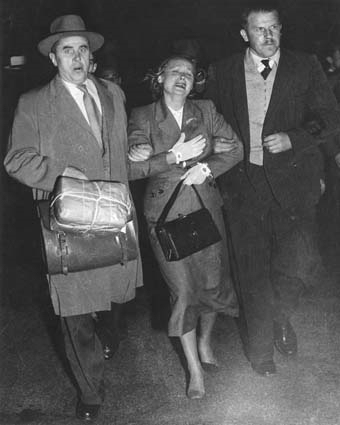 |
| Evdokia Petrova (Petrov's Wife) being led away, for a plane back to Russia. She managed to get help and stay in Australia. (1954). Taken from Wikimedia. |
Australia was colonised by the British, as I'm sure most people know. But that doesn't mean it was only the English who colonised the island. One of the largest groups to come to Australia in the pre-federation (1901) period were the Irish. Let's face it, the British have always wanted to send the Irish they didn't like to the other side of the world, and a prison colony let them do this. Add to this the Australian gold-rush occurring at the same time as the Irish potato famine, and you're probably starting to get an idea of how many Irish immigrants there were. As even my fictional name, Hudson Rourke, will attest, I have a lot to thank these immigrants for. Namely, my existence here.
The vast amounts of Irish immigrants and the British immigrants did not get along very well, and a rift emerged in society as a whole. As recently as the 70s or 80s, you can still see the Irish-English divide. The end of White Australia pretty much ended this kind of petty squabble. The main forum for this fight was the church. English Anglicans against Irish Roman Catholics.
The majority of the Labor leadership was Anglican, while in areas like Victoria the party was largely of Irish heritage, and thus Roman Catholic. Enter B.A Santamaria, who is the most notable influence on the creation of the party, and his Democratic Labor Party (still spelt the American way).
 |
| The slogan would have worked better had they actually spelt Labor with a U in their party name. They eventually did change it, to be fair. |
That pretty much explains the 1950s. I'll try to be a bit more blunt in explaining the 1970s:
Let's start with probably the most important event to happen in Australian history in the latter half of the 20th Century.
If you didn't quite get the point, it's the Vietnam War. Australia wholeheartedly participated in the Vietnam War, and it has left a cultural impact more than almost any other event. For example, that song was originally performed by Redgum in the 80s, and this version was recorded in '06. Australia is still recovering in many ways.
I won't go into the history of the Vietnam War today, but all you really need to know is that it created an even wider gulf in the political landscape. Either you supported the righteous war against the Communists, or you opposed the senseless slaughter of Vietnamese civilians in the name of ideologies. As the 60s turned into the 70s, and the body count of Australians started to rise, less and less people supported the former.
Australia's relationship with America during this period certainly concerned many Australians. As Holt vowed that, in regards to the Vietnam war, we'd go "All the way with LBJ", images like the one below made Australians wonder how much we were letting America run our country.
 |
| President Johnson (left) and Prime Minister Holt (right) in a somewhat telling image of Australian-American relations. Photo details here. |
 |
| The Tent Embassy was an Indigenous Australian undertaking, arguing that the Australian government was so unreceptive to their needs that they were a foreign country, and required an embassy in the capital. More info here. |
Well, the board is set. The right is losing power. The force that was Robert Menzies has retired, his successor, Harold Holt, disappeared while swimming, and has still not been found to this day. McEwan & McMahon had short and forgettable runs. Vietnam, racism and a wish for change were coming. You could, in fact, say...
Wednesday, 15 October 2014
InAnimete: Part 9 - Vandread
Oh, this is going to be a fun one. To read, I mean. It's going to be an absolute bastard to write. I still hold a grudge against my friends who followed up Angel Beats with fucking Vandread. I will openly admit that a fair amount of my dislike for this show is based on its place in space for me. The second not-maid anime, following on from an anime I still call my favourite of all time. I can't think of any anime which wouldn't have a tough time living up to that. I probably would have been better off having something irredeemably shit like Vampire Knight or Code Geass fill this slot instead of something with potential. Well, let's get moving.
Plot:
OK, so I'm gonna spoil in this review. Just a heads up. I don't really care for an anime like this, but just letting you know.
Anyway, we find ourselves in a universe not that far away, in which men and women have been divided into two completely different empires. The men are crazy and militaristic, and the women aren't much better, which is a nice touch...I guess. The main character, from the male empire, finds himself prisoner on a female pirate ship. Hijinks ensue.
Normally this is where I'd start talking about characters. I really can't do that with Vandread. Is it too innovative? Too avant garde? To "edgy"? Not quite. In reality, the main characters are just too generic to have anything to say about. Sure, I hate a lot of them, but not in creative ways. Hibiki is generic and does nothing. Dita acts like a child, and that's the joke. There's the pilot. He has that one episode that was sweet. There's Dr. McDreamy, who's the only adult among the males. He doesn't have a story, he just kinda does stuff that doesn't add up to anything. There's the generic inventor. She's alright, if kinda cliched. Erm...the amorous woman who's always after the pilot or Hibiki. She's there, but I don't know what to say about her. There are two characters I DO like, but we'll have to get to them in a while. If I didn't mention a character, presume its because they were too dull for me to remember.
So, instead of character, what am I gonna talk about? Fucked if I know. Let's just see where we end up going.
What I'm gonna start with is the portrayal of gender in this show's universe. As I mentioned, the women in this show are just as horribly violent as the men as a society. The name of the show is a portmanteau of the names of their ships, showing they have similar societies. That's pretty good, considering my first thought was that this was the dream society of one of the angry misogynists who inhabit the internet.
It is, admittedly, not nearly as bad as the Mississippi situation, but there are still a few issues. Women still have stereotypical traits of our society. For proof of this, just look at the clothing. The female cast members largely wear skirts and dresses. How is it that in a situation so far removed both geographically and chronologically from our society that clothing is still so strictly delineated between the genders, who have been cut off from each other for generations? The pregnant woman, in particular, is an outright stereotype in many regards. Dita isn't much better. Just because you have a woman fly a space-fighter doesn't prevent her being a groan-worthy cliche back on the mothership.
Dita is overly sensitive, clingy, emotional, excitable, childish and obsessed with Hibiki. Hibiki is aloof, angry at concepts which are never really built upon, anti-social, pointlessly dickish towards Dita, and violent. It's comforting in a way to see that society will have the same gendered cliches so far into the future. Good to know if I end up like Fry, I'll be able to comfortably slip back into a gender studies course at any nearby university after getting my bearings.
The space-fights are boring and poorly animated. Considering the amount of my time invested in watching lousy CG spaceship shoot lights at each other, I wish there was more I could say. There were half-hearted attempts to characterise during the fight scenes, but they always were too short and insignificant to be worth it. The best episodes were unsurprisingly those that were lightest on fight scenes. Although the "plot" wasn't fantastic, it was always a relief when the battle ended and I could tab back onto the appropriate window to continue.
I would love to be able to say something meaningful and important about the show, but I can't because neither of those words are at all applicable to this series. It isn't the most generic sci-fi I've ever seen (we'll get to that next time), as the premise and the twists at the end both really differ from a basic space-opera. Well, I guess this is going to be a shorter than usual review, 'cause I've got next to nothing to say. But before I finish, let's talk about the two characters I really did like.
First is the Captain. A pirate, and surrounded with the vaguely indigenous American imagery of the ship (which is a really neat touch by the way. The men tend to use an industrial nightmare motif in response), the Captain is the driving force on the ship. I like her because she manages to be commanding and almost sinister while ageing, not particularly tall and in no way conveying menace in her appearance. Her command is clearly rendered from the fact that every single person on that ship is in absolute deference to her. She holds this ship together, and is a celebrity on her home planet. Nothing about her is inherently gendered. She just gets on with the job, taking care of her crew all the way.
The other character is the 2nd in command, BC. BC is a tall, imposing ambiguously brown woman with elaborate silver hair (did I mention this anime has generic character designs a lot of the time? Well, I'll say it again). She is the main force by which the captain interacts with the crew, presumably due to her age and intentions of not wanting to put up with bullshit. The twist, and I spoil with little hesitation, is that BC is actually a man, disguised as a woman, who is a spy for the male empire. The usual conversion and display of loyalty occurs, and BC returns to the fold of the ship and her crew. BC is a fascinating character because she fucking does something and doesn't just wait for the plot to throw shit at her. She fights the empire she's been raised in, and joins the empire she was raised to hate. She just generally takes command and tells Hibiki to get the fuck over himself, which is a stance I support wholeheartedly.
Well, that's it for Vandread. Sorry this review is so short, or I guess you're welcome if for some reason you hate my work but feel obliged to read it anyway. The problem with Vandread is the thing I'm sure every reviewer will attest to: it can be really good or bad, but the worst possible scenario is that it's just average or boring. There is so little to say about something that's dull or mediocre. That's Vandread. It's not so much boring as average. There's stuff I like about it and stuff I don't, but I don't feel passionately either way about anything in particular. It had some sweet design ideas, but some lousy characters. The plot went in interesting directions, but only when not weighed down with seemingly endless dogfights. The idea of a predominantly female cast is really appealing to me as something different, but the spotlight is mainly on a male character, and most of the women become little more than stereotypes and fanservice.
I don't like this anime in total, but it wasn't an easy conclusion to reach. If there was just something that made it more remarkable I could really feel something towards it, but it's just full of little mistakes and little redemptions. I don't recommend it at all, because there's nothing to gain from it. All in all, it may be the worst follow up to Angel Beats imaginable.Next week we move into yet another dangerously mediocre sci-fi anime in the form of Kiddy Grade. I just fucking hope I think of something other to say between now and then except "meh".
Anyway, cheers for reading.
H. Rourke
Plot:
OK, so I'm gonna spoil in this review. Just a heads up. I don't really care for an anime like this, but just letting you know.
Anyway, we find ourselves in a universe not that far away, in which men and women have been divided into two completely different empires. The men are crazy and militaristic, and the women aren't much better, which is a nice touch...I guess. The main character, from the male empire, finds himself prisoner on a female pirate ship. Hijinks ensue.
Normally this is where I'd start talking about characters. I really can't do that with Vandread. Is it too innovative? Too avant garde? To "edgy"? Not quite. In reality, the main characters are just too generic to have anything to say about. Sure, I hate a lot of them, but not in creative ways. Hibiki is generic and does nothing. Dita acts like a child, and that's the joke. There's the pilot. He has that one episode that was sweet. There's Dr. McDreamy, who's the only adult among the males. He doesn't have a story, he just kinda does stuff that doesn't add up to anything. There's the generic inventor. She's alright, if kinda cliched. Erm...the amorous woman who's always after the pilot or Hibiki. She's there, but I don't know what to say about her. There are two characters I DO like, but we'll have to get to them in a while. If I didn't mention a character, presume its because they were too dull for me to remember.
So, instead of character, what am I gonna talk about? Fucked if I know. Let's just see where we end up going.
What I'm gonna start with is the portrayal of gender in this show's universe. As I mentioned, the women in this show are just as horribly violent as the men as a society. The name of the show is a portmanteau of the names of their ships, showing they have similar societies. That's pretty good, considering my first thought was that this was the dream society of one of the angry misogynists who inhabit the internet.
It is, admittedly, not nearly as bad as the Mississippi situation, but there are still a few issues. Women still have stereotypical traits of our society. For proof of this, just look at the clothing. The female cast members largely wear skirts and dresses. How is it that in a situation so far removed both geographically and chronologically from our society that clothing is still so strictly delineated between the genders, who have been cut off from each other for generations? The pregnant woman, in particular, is an outright stereotype in many regards. Dita isn't much better. Just because you have a woman fly a space-fighter doesn't prevent her being a groan-worthy cliche back on the mothership.
Dita is overly sensitive, clingy, emotional, excitable, childish and obsessed with Hibiki. Hibiki is aloof, angry at concepts which are never really built upon, anti-social, pointlessly dickish towards Dita, and violent. It's comforting in a way to see that society will have the same gendered cliches so far into the future. Good to know if I end up like Fry, I'll be able to comfortably slip back into a gender studies course at any nearby university after getting my bearings.
The space-fights are boring and poorly animated. Considering the amount of my time invested in watching lousy CG spaceship shoot lights at each other, I wish there was more I could say. There were half-hearted attempts to characterise during the fight scenes, but they always were too short and insignificant to be worth it. The best episodes were unsurprisingly those that were lightest on fight scenes. Although the "plot" wasn't fantastic, it was always a relief when the battle ended and I could tab back onto the appropriate window to continue.
I would love to be able to say something meaningful and important about the show, but I can't because neither of those words are at all applicable to this series. It isn't the most generic sci-fi I've ever seen (we'll get to that next time), as the premise and the twists at the end both really differ from a basic space-opera. Well, I guess this is going to be a shorter than usual review, 'cause I've got next to nothing to say. But before I finish, let's talk about the two characters I really did like.
First is the Captain. A pirate, and surrounded with the vaguely indigenous American imagery of the ship (which is a really neat touch by the way. The men tend to use an industrial nightmare motif in response), the Captain is the driving force on the ship. I like her because she manages to be commanding and almost sinister while ageing, not particularly tall and in no way conveying menace in her appearance. Her command is clearly rendered from the fact that every single person on that ship is in absolute deference to her. She holds this ship together, and is a celebrity on her home planet. Nothing about her is inherently gendered. She just gets on with the job, taking care of her crew all the way.
The other character is the 2nd in command, BC. BC is a tall, imposing ambiguously brown woman with elaborate silver hair (did I mention this anime has generic character designs a lot of the time? Well, I'll say it again). She is the main force by which the captain interacts with the crew, presumably due to her age and intentions of not wanting to put up with bullshit. The twist, and I spoil with little hesitation, is that BC is actually a man, disguised as a woman, who is a spy for the male empire. The usual conversion and display of loyalty occurs, and BC returns to the fold of the ship and her crew. BC is a fascinating character because she fucking does something and doesn't just wait for the plot to throw shit at her. She fights the empire she's been raised in, and joins the empire she was raised to hate. She just generally takes command and tells Hibiki to get the fuck over himself, which is a stance I support wholeheartedly.
Well, that's it for Vandread. Sorry this review is so short, or I guess you're welcome if for some reason you hate my work but feel obliged to read it anyway. The problem with Vandread is the thing I'm sure every reviewer will attest to: it can be really good or bad, but the worst possible scenario is that it's just average or boring. There is so little to say about something that's dull or mediocre. That's Vandread. It's not so much boring as average. There's stuff I like about it and stuff I don't, but I don't feel passionately either way about anything in particular. It had some sweet design ideas, but some lousy characters. The plot went in interesting directions, but only when not weighed down with seemingly endless dogfights. The idea of a predominantly female cast is really appealing to me as something different, but the spotlight is mainly on a male character, and most of the women become little more than stereotypes and fanservice.
I don't like this anime in total, but it wasn't an easy conclusion to reach. If there was just something that made it more remarkable I could really feel something towards it, but it's just full of little mistakes and little redemptions. I don't recommend it at all, because there's nothing to gain from it. All in all, it may be the worst follow up to Angel Beats imaginable.Next week we move into yet another dangerously mediocre sci-fi anime in the form of Kiddy Grade. I just fucking hope I think of something other to say between now and then except "meh".
Anyway, cheers for reading.
H. Rourke
Tuesday, 7 October 2014
InAnimete: Part 8 - Angel Beats
OK. Let's get some things straight. I am going to under-state this show. This is my favourite anime of all time (so far, I guess, but I doubt I'm gonna back down from this any time soon). In attempting to prevent understating it, I'm going to overhype it. So...long story short, just ignore me. Set? Good.
OK, let me try that again: Angel Beats is fucking glorious. But it isn't groundbreaking. It's strength isn't from doing things groundbreaking and new, although there's a bit of that in there, but more-so from doing what many anime do, only better.
Going into this anime expecting something completely new is not gonna be good. Expecting what you've seen before pulled off very, very well is more like it. Think about what most people seem to think makes Cowboy Bebop so brilliant (I'm not a huge fan myself, but ignore that) is the fact it isn't filled with anime tropes and cliches. It tries to completely remake the medium. I'll cite Bennett the Sage's nostalgia-drenched review as an example of this. Angel Beats is an anime-anime. It couldn't be confused with anything else. And it's fucking brilliant. There. That's the best I can do. If you're the wrong level of hyped, for those who haven't seen it, I can't help you.
Maybe I should just get on with the usual sub-headings:
Plot:
Yep. It certainly has one of these.
...
...
...
Fiiiiine. Otonashi wakes up on the grounds of a school in the middle of the night. He can't remember anything about how he got here, or who he is, but he is wearing a school uniform. A girl, also in uniform runs past him, wielding a helluva rifle. She, Yuri, tells Otonashi he is dead, and they are fighting against God. That's all the plot you're getting. If you've seen Angel Beats, you already know exactly how this story goes. If you haven't a) I'm not going to give more away and b) Leave this page. Now. Through here. I'll see you in a seasons time. Cheers for reading.
And this is where the spoiler cap comes off. Despite the setting of the show being inherently never-changing, the characters constantly returning to a set default and the general implication that this world has been operating in a constant state until Otonashi arrives, this is perhaps the most dynamic anime I've ever seen. Nothing is constant. If you miss an episode, there is a chance things have changed forever. There is no default. And I fucking love it.
The issue is, of course, that I will spoil in the nature of just talking about character development. So, even if you've seen SOME of the show, take the chance I'm giving you to leave. Please. Don't let me rob you of this experience. For both of our sakes. OK, warnings done.
Otonashi:
I love Otonashi on so many levels. There are many characters to adore in this show. Yuri is, of course, a favourite, and I think Tenshi also has a decent following, but Otonashi is my favourite. If I couldn't remember his name, my nickname for him would be "Anti-Suzuki". He inverts the self-insert amnesiac boy trope so very beautifully.
So - for those of us who have seen this show, or those who can't take a fucking hint to watch it, let's just have a reeeaaal quick overview of Otonashi (the name of whom I keep trying to shove an extra "o" into for some reason, but hopefully I'll fix that in editing). Otonashi, the protagonist through which we explore this universe, was crushed by the death of his sister at a young age, and turned his life around to become a doctor, only to die in a train-crash/tunnel cave-in.
Now, let's talk about that episode, in which he returns to the caved-in tunnel to die. This, for the record, is my favourite episode, and the one in which I finally cried. Not even the finale has that feather in its cap. Now, some of my friends interpreted this as Otonashi coming back to life, as time clearly does not run at the same pace in this limbo as in the real world. I, however always look at it as him simply regaining his memory due to his closeness to Tenshi. I'm interested in what anyone thinks about this, just as an aside. Is there another interpretation?
Anyway, actually analysing the character. Now as I mentioned, Otonashi is an inversion of the self-insert character. He starts out so very cliched - he is an amnesiac, so as to provide an avenue in which the viewer can explore the world afresh. This is inverted from the very start: there is no reason to wipe his memory so as to explore this world - he has never been here before. The amnesia is to provide no information dump about the world, but to allow a slower trickle of information from Otonashi's past. Ask yourself: If Otonashi, like every other character, maintained his memories, how would you convey his story to the viewer? An awkward backstory exchange with another character? It would slow the pace remarkably, but is conceivable. Give us the story before meeting Yuri? Also plausible, but also a bit of a momentum train, and it would be difficult to grasp the significance of the story that early in the show. As well, it would be difficult to provide a decent narrative hook from that story alone. That story, until the tunnel, is over. There is nowhere to go from there.
He also inverts the entire viewer-insert character trope by having, to be blunt, a personality. Let me put this simply: male leads in anime don't tend to have personalities, or at least personalities worth having. Kid Hanaukyo's defining characteristic is he'sa better slave owner less of an arsehole than his grandfather. Hayate's personality is that he's a handsome doormat. These are not personalities you'd curse a background character with in a decent story, but the viewer needs a character they can pretend to be right? RIGHT?!
Otonashi is loving, driven, affectionate, emotive, non-athletic, aversive to confrontation, gentle, average in intelligence, friendly and so, so, so much more. He's a great guy, but realistic enough to avoid the bishie sparkles. This absolutely fantastic review sums it up so much better than I ever could, in a way. I paraphrase when I say: In what other anime is the female lead the gun-toting military mastermind and the male lead saves the day by hugging a villain and letting him knows he is loved? Seriously, if someone can answer that, I'll be able to say definitively what I'm watching next.
OK, I'll wrap up Otonashi here. He's a genuinely great character. I love the fact that a male character can be portrayed as compassionate without being somehow emotionally weak, or a background character. Tenshi, Yuri and Masami all have their fans, and they certainly deserve them, but I firmly say Otonashi is my absolute favourite character, from my absolute favourite anime.
Yuri:
Well, I've established Otonashi as my favourite character, but in no way should I say it's all downhill from there. There is certainly a reason that Yuri and Tenshi are the faces of this series. When it comes to a nickname for Yuri, I'm kinda glad I didn't have to choose. I was tossing up between Big Sister, or Ensslin or Meinhof or Tanya. Something other than the typical female "war" names. Y'know the ones: Amazon, Valkyrie, Warrior-woman. Those are waaaaay too cliched for Yuri. Yuri isn't the cliched type in any way. She isn't the pointlessly angry caricature, some woman vaguely scorned. She is pissed off at God, and she has every goddamn reason to be so.
As a quick recap: Yuri, head of the military unit which is the focus of the show, is the gun-totting action character who supplies much of the adrenaline for the show. She was the eldest sister of a large family before all of her siblings were slaughtered in a way labelled as her fault. Her death is never explained, although I would bloody love to find out. As the manga explains, Yuri has been at the school longer than anyone else, bar Tenshi and the Gunsmith. She is filled with anger, and her endless campaign against the perceived forces of God is the product of her backstory.
The first thing worth noting about Yuri is that she's a damn good military commander. Considering she's leading a guerrilla faction against a much larger enemy, both of the school and the deities who apparently reside within, she organises them well, especially when you look at her means of weapon manufacture. Beyond mere strategy, as her elaborate Operation names demonstrate, she also is really good at keeping up morale. In a world where nothing changes, no victories can be permanently won (with the exception, I suppose, of the Principle's Office), enemies killed, or lessons learnt it would be so easy to become disheartened. But Yuri manages to keep people on their toes enough to not disappear but also fosters a sense of community and belonging that keeps anyone from storming off. Considering she's a teenager attempting to herd other teenagers with no granted authority, she does a damn good job.
She also uses her alliances well. She manages to get both the massive underground weapons manufacturers (that really needs a goddamn backstory) setup, and also get the school band onside. She knows what resources are available, and uses them to her advantage. I didn't pick the names Ensslin, Meinhof and Tanya merely because they were women associated with violence. Ensslin was a skilled military and tactical leader of the RAF, Meinhof was in charge of manifestos and group ideology and "Tanya", better known as Patty Hearst had a very similar style of appearance to Yuri. Sure, that last one is pretty cheap, but I'll stand by it. By the end of this series, when I will have called literally dozens, if not hundreds, of characters "Suzuki", "Fanservice" or "Glasses", this will seem justified.
I'm not sure what else to say about Yuri. Like Otonashi, she stands completely against gender roles, something I'd respect in any form of media, but a million times moreso in anime, which tends to have many characters cast simply to be attractive, traditional girls and women. As always, nothing wrong with being traditional, but there has been more than enough stories about the girl who doesn't want to fight because that's men's business. Change and variety is invariably good. Yuri, unlike Otonashi in many ways, stands against ageist stereotypes. While Otonashi is caring and empathetic, Yuri shows a military and organisational mind beyond her unspecified number of years.
I feel like my analysis of Yuri was really just talking about how much her military set-up kicks arse, but that's important. Every centimetre of ground held by the group was her doing. Every member of the group was hand-picked, or at least consulted, by Yuri. The entire setup, the elaborate size and scope of a guerrilla group, reflects her mind, her goals and the way in which she expects this war to be waged. The entire setup of this school can be considered a reflection of her mind and emotional state...like the third Pokemon movie. I'll take my prize from the terrible simile Olympics, and we can move on.
Tenshi:
It's in writing about Tenshi that I really feel the weakness of my "on-character-at-a-time" review/analysis style. Tenshi is important because she makes up the triumvirate which drives the entire anime. Really, it's relationships between Otonashi and Yuri that start the show. The main driving force for the first half of the show is the war between Yuri and Tenshi. The relationship between Otonashi and Tenshi strains the clear-cut nature of the war, resulting in a relationship emerging between Tenshi and Yuri. The final scene is between Tenshi and Otonashi. This isn't to say the other characters are unimportant. They certainly are. I wouldn't be able to argue Angel Beats with just these three would be remarkably interesting, as unique as the approach would be.
Now to write about Tenshi, let me sell the plot of Angel Beats in a different way:
A girl arrives in a world beyond life. In it she finds others such as herself. All alone, she realises that when these others are happy, they move on, clearly to a better place. This girl dedicates herself to helping these move on, while settling into the strange world she is in. She assumes a position of authority, requiring effort, the respect of her peers and teachers, good grades and a general motivation to strive for the best situation for everyone.
And then Yuri arrives. Yuri, brandishing illegally manufactured weapons and a pseudo-guerrilla facade, decides that this girl is specifically to blame for all that is wrong with Yuri's life. This girl stops being "Class Rep. Tachibana" and instead becomes the darkly ominous "Tenshi" or "Angel" to Yuri. Yuri and her gang undertake a campaign of merciless bullying towards "Tenshi", destroying every moment of peace, of joy, of contemplation, of respect or of accomplishment. When "Tenshi" attempts to use her hard-earned knowledge of the logic of this universe to defend herself, Yuri sees it both of a sign of vindication, that indeed "Tenshi" is to blame for this world, and also that she is winning this fight, and redoubles her efforts to destroy the "Angel" who runs this world. Finally, in a climax of Yuri's campaign, "Tenshi"is robbed of the one sign of her authority and dedication - her role as class rep, along with the respect of her peers and teachers.
I'm sure that I'm forgetting parts of that story, as it's been about 8 or 9 months since I saw Angel Beats, but my summary still reflects the core premise of the show - the villain is Yuri. I'm not sure, however, that this renders Tenshi the hero. To play angel's advocate, she doesn't exactly try to mend bridges. Instead of attempting to address Yuri's claims, Tenshi escalates the conflict by arming herself. That said, Yuri's "claims" are so removed from the reality Tenshi resides in they would be remarkably difficult to refute. Not to mention, Yuri likely never actually took the time to explain to Tenshi why she hated her. To Tenshi, it would naturally look like Yuri was just an angry, vengeful bully. Which she is, exactly.
It's difficult to talk about Tenshi without mentioning other characters, because almost everything Tenshi does is remarkably reactionary. Her rise to power is a reaction to her environment, her fights with Yuri are a result of Yuri's war with her, and even her love-interest sub-plot with Otonashi has to wait until Otonashi comes to his senses and drops out of Yuri's war. She's certainly a very capable and intelligent character, but she still tends to operate in reaction.
One relationship that remains unexplored that I would be absolutely fascinated with is that between Tenshi and the Genocidal Potter, her deputy and later replacement. Did she realise he was human? That he was angry? That he was murderous? Was he in this position because of her? Despite her? I don't know, but I'd love to. Tenshi wasn't exactly the warm beating heart of the show, but I'd be interested to see what impact she had on the Potter.
Overall, Tenshi is one of the most important and interesting parts of this show, albeit more as a plot element then as a character. Villains becoming allies is nothing new to anime, I've seen Ranma 1/2, but the main and realistically ONLY villain giving up the "fight", only for the show to stop and realise it doesn't actually have a villain is a brilliant, brilliant move which I couldn't respect more. Tenshi stands as one of the most unreadable and interpretive characters in anime.
Masami:
From my group of friends, I understand that Masami has quite a following. This can also be seen in the previously cited review. The third image, specifically, features her prominently. Now, I'm going to be pretty honest here: I don't have much to say about her. Not to say I don't like her. She's neither the character I like the least nor the character I feel is the blandest. She just has a damn short arc, and I found her only kicking around in the very back of my mind when I sat down to write this review.
So, as a quick reminder: Masami is the lead singer/guitarist of Girls Dead Monster, the all-girl school band. She comes from a really rough background and her only outlet was music. In a drunken rage, her father renders her paralysed, unable to sing or move. She finds joy in finally rebelling, acting out against the system, and disappears into the after-afterlife. I need a better name for it.
The most notable fact is that this all occurs in the space of an episode. Masami reveals her demons, her past, and finally achieves her desires all in one fell swoop, in episode 3. It, in my opinion, walks a veeeerrrry thin line between "rushed" and "self-encapsulating". In reality, it's both.
Sure Masami's episode is a rush to the finish. The entire fucking series is rushed. Masami, in many ways, is done an injustice by being introduced (more or less) and disposed of in less than a half-hour. No matter how good a character and her story are, having her gone before the first quarter of the show is passed renders her seemingly unimportant in the broader scheme of things.
That might be a bit harsh, on some level. Masami's arc is, absolutely, self-contained. And it does serve a purpose. It proves that at least some of what Yuri and her gang are telling Otonashi. A character interacts with the afterlife too much and moves on to the next level. This is vital. One problem I had with Yuri was her "NPC" theory. She never manages to actually prove this. Because, frankly, she can't. Not to say ALL the characters in this school were real - the re-locating of the principle in the manga is great proof that they do react like poorly programmed AI, but Otonashi hasn't read the manga (and neither have I. Because it is the slowest translation project ever.). He accepts it WAAAAY too easily. This is a way of informing the audience that at least some of what Yuri says is real. People DO disappear. Sure, the circumstances are not as tragic as Yuri implies, but that's more planting seeds of doubt about how reliable a narrator a rage-fuelled guerrilla-commanding teenager really is.
Ultimately, Masami is a means to an end - show how the world works. She's also a great tragic figure, left in a state of self-loathing, finally given a means of expression. Her sacrifice was for the good of the show, as Angel Beats isn't so cheap as to cook up a storyless mook to kill off. Masami - a kick arse anime plot device, who goes out in a blaze of glory. In her defence, she gets "killed" of in a better way than any other character in the entire show.
Baseball:
Yeah, I can't remember his name. And I don't really care enough to look it up. No offence to the character, but the name isn't really important. The name? He likes baseball. He REALLY likes baseball. He nearly dies during a baseball game. Yeah, that guy.
OK, a better summary. Baseball is really the closest Otonashi has to a friend in this universe, at least before meeting Tenshi. Yuri is a friend in the loosest possible manner. She has better things to do, and commands at a distance. Baseball also is the love interest of Yui. Oh Yui. We'll get to her in a moment. Anyway, Baseball gets the honour of being part of the last 5, so that's something.
OK, I have problems with Baseball. He's kinda bland. I mean, really bland. He is sorta the protagonist trope for this anime, filling the requisite quote. The fact he is the protagonist of the manga, set before Otonashi's arrival, is pretty obvious. He and Otonashi have quite a lot in common in how they behave and react to situations around them, providing a straight man for the beautiful anarchy around them.
I don't wish to say Baseball is a bad character. Angel Beats doesn't really have BAD characters, as much as they have varying amounts of good. I'm sure that sentence makes sense to someone out there. As levels of good go, Baseball isn't even at the bottom. His plot makes the near-inexplicable baseball (game not character) episode interesting, giving it a little pathos. Seriously, this show is running on road-runner time for the whole series. Who thought "baseball episode" was an intelligent investment of time? Baseball and Yui also make an interesting couple. The bland, reliable and cliched bloke and the wild, manic, marginally less cliched girl seem to get along well.
I like the way Baseball's backstory is handled. We see just enough to know why he had a shit time in school without the time being invested for a full-on flashback like Misami and Otonashi. I wish this had been done for more of the main cast. I mean, seriously, I fucking love TK, because he speaks English like I speak Spanish. Why couldn't there be a 10 second sequence of connotative imagery to convey his backstory? Still, it's a decent style to use.
Baseball is a decent character, providing the role of a straightman to Yui, Yuri and, to a degree, demonstrating what Otonashi can do that the average boy can't. He has a role and he fills it. Again, Angel Beats does what most anime do, only better. I can't say this isn't an anime character.
Yui:
Don't ask me why I remember Yui's name and not Baseball's. That's just how my mind works. Her nickname would have been "Pink" for very obvious reasons. To put the character simply, I don't like Yui. She's just way to cute and bubbly and energetic to fit the tone of the show. Also, she has a tail, I swear. And this is never addressed. She just has a tail. If it weren't for her backstory, I would be wondering if she got lost on her way to a more cutesy anime.
Yui recap: the youngest looking of the group (other than Tenshi, I guess), with pink hair, Yui is constantly perky and bright. She attempts to act cute at every turn, and is sickeningly aware of it. She and Baseball seem to have a cat and dog relationship, before they fall for each other. Both Yui's personality and the relationship between her and Baseball are cliche, but again, Angel Beats is the most anime thing ever. I kinda have to respect that. Yui was, in live, paralysed from a young age from the neck down, prevented from doing any physical activity.
With that backstory, I kinda get Yui. She wants to do all the things she didn't do in life. That's fine. She also loves being able to move and hates standing still for any significant period of time. Again, I get it. It doesn't stop the fact I find her infinitely annoying. I groaned the first time I realised she wasn't going to be a one-episode wonder. Her back story is really good. It's interesting, and explains a lot about her. I get it. Still, I find her personality a little grating.
The romance between Baseball and Yui is, as I've already said twice, well handled. The two compliment each other well, but more importantly, their relationship is well explained. The montage in which Baseball proposes how the two could have met in real life is genuinely brilliant. I had no idea what it was meant to be when I saw it (please remember I had finished "They Are My Noble Masters" before going into this. "Imagination" and "creativity" were alien concepts in anime for me at this point), but when I twigged, I thought it was really well done. Even just having Yui display that hint of self-awareness, a scepticism that Baseball would have cared about her during life, did an enormous amount to humanise her in my eyes.
Yui isn't poorly written. She isn't horrible in any way really. She even goes a little way towards inverting some tropes. But, all that said, she was perhaps my largest problem with the series, or at least amongst the largest. I see her role, her place, her angle and her use, but I'm still not a fan. The fact she replaces Masami seems to be something some hold against her, but I couldn't care less about that, honestly. Apparently being paralysed in life makes you a really good singer and guitar player (yes, I realise Masami was already good at both, but Yui has no excuse). Yui: She exists, perhaps a little too much.
Potter:
Potter is probably gonna be the last character I look at. I'd love to do more, but a) my reviews only take 1-3 hours to write, but this is the third day of me occasionally pecking away at it and b) usually run for about 3000 words, but this is 4300 and counting and c) the other characters get less screen time than most of the ones I've covered, so I've got less to say, unfortunately. Please also recall it's been 3/4 of a year since I watched this show. Some subtle elements may have escaped me since then.
Anyway, Potter. Potter is a fascinating character. As reminder, he is Tenshi's deputy and once Yuri fucks up her exams, Potter takes her place. At which point he kills everyone. Honestly, considering how fucked up every single one of these kids are, I'm surprised a mass killing didn't happen earlier. In life, he was one of two sons of a famous potter, known worldwide for his work. His brother inherited his father's skill, while Potter did not. After Potter's brother dies in an accident, he becomes his brother in the eyes of the world. There are many things you could do to fuck a kid up, and essentially telling him that you would rather he had died is pretty high on that list.
Anyway, after he goes on the killing spree, the scene of Otonashi hugging him and letting Potter know that someone cares about him occurs. This is perhaps my favourite scene of Angel Beats. It encompasses so very, very much. All the violence, all the guns, all the guerrilla warfare leads to nought. An act of affection, of empathy is the only way in which the only individual who actually has any ill-will towards Yuri's gang is dealt with. That's the moral of this story. I bloody swear it is. It has to be. This is a story of emotions being much more powerful than anything else, and as an anime targeted at teenagers, what better moral could a story have? What more important lesson could you walk away from an anime with?
There are anime that seem to say nothing, or even less than nothing. Reinforcing stale, horrid narratives and ideas that need to die. Just contrast the morals and ideals of Angel Beats to a genuinely vile anime like Code Geass or Vampire Knight. Or even a good anime with confused messages, like Strawberry Eggs. It feels odd to compliment an anime on being "on message", but that's exactly what Angel Beats is, and the hug between Potter (God I wish I could remember his name) and Otonashi reinforces, proves and endorses this message of being open, expressing what you want to say and listening to others. It's beautiful.
Potter calms down and joins Yuri, being a little bit of an outcast because of the whole "killing everyone" thing, and I feel that's probably realistic. There isn't much more of a punishment you can give the guy in this world other than a little bit of social ostracism.
Potter is one of the final 5, so that's something, I guess. He's a genuinely good character, and he represents a lot that really isn't addressed in the other kids. The darkness he demonstrates against Yuri is fascinating. Especially when you realise that Yuri replicates that in a lot of ways. Her resorting to violence for everything, her hatred for Tenshi as a symbol of what she didn't understand, her lust for revenge. Potter represents this in a way that is much easier to address, because he is an outsider, rather than a friend of Otonashi who snaps. Overall, Potter doesn't manage to match his role as a villain in importance while a hero, but that doesn't really matter. He came into this world angry and depressed, and wasn't as lucky as Otonashi to find friends. He certainly demonstrates something about how this world should be read.
Conclusion:
Well, I think I've argued pretty comprehensively why this show is fantastic. It uses the media of anime to the best of its ability, it reworks old tropes and cliches to make them suit the setting, it has a fantastic cast of characters and it should and certainly will go down in history as one of the greatest shows, anime or otherwise, of all time. At least as far as I'm concerned.
So for the conclusion, let me mix it up a little and talk about where Angel Beats fails.
As much as I whined about Yui, she wasn't a "failure" really. I see what the show was trying to do with her, and it succeeded. I just didn't like it. Some episodes felt a little meandering, but it was attempting to introduce us to a decently sized cast in a very short period of time, and needed us to relax with them for a while.
That "short period of time" bullshit was a goddamn problem. This entire show runs for 13 episodes. That's bullshit. There was sooooo much more that needed to be done. I wanted to see so much more of this show and every element it presented. It has so much potential. For context, my second favourite anime has run for over 200 episodes, has a movie, and there is no reason that a 5th season or a second movie won't come to be. Angel Beats has a constantly delayed Visual Novel, and a gradually fan-translated manga. I may be missing something here.
The other problem with the speed in which Angel Beats runs is that it doesn't work thematically. In a show like Mahoromatic, for example, where the issue of mortality is front and centre, a short run would make a lot of sense. We only get a short time, make the most of it. Angel Beats, in the setting and themes, isn't about mortality. It's about the lack of mortality. It's about a world that lingers and repeats. It's about an infinity confined. Sure, we didn't need to be getting into Hayate no Gotoku figures with episode count, but 13 seems to be selling this world and concept so very short.
Leaving out some petty complaints, I really only have one other MAJOR complaint. That would be the ending. The ending of Angel Beats can go fuck itself. I don't mean Tenshi and Otonashi. I don't mean graduation. I mean "Where did everyone go?" " They moved on". Everyone. Fucking everyone. So we'll never know what the stories of TK or 5th Dan were. We just have to presume that they had a desire which was met in the few days Yuri was out. The fuck. Why could they not have remained? I mean, I GUESS it's a happy ending for them, but I feel it really isn't for us. I loved every moment of this show, and I'm not so unaware as to call myself "ripped off", but that's pretty close to the sentiment I'm harbouring. The three days where Yuri was unconscious needs to be its own 20 episode series, in which we find out how every member of Yuri's gang managed to move on. With at least 3 of these episodes on TK. I fucking loved TK.
Also, I'm not even gonna try and interpret the last scene of the series. I don't know.
Anyway, Angel Beats is an utterly fantastic show, and is my favourite of all time with an amazing distance between it and the closest runner up. If you haven't seen it, you have done yourself a terrible disservice by reading this far. Make it up to yourself by reading what has been translated of the manga, starring Baseball. And seriously, just fucking watch this show. It's not going to kill you, except emotionally.
Also, feel free to play the drinking game of going back and taking a shot every time I refer to the "Angle Beast", because I am a terrible self editor. I'll be back sometime in the near future with my second on my "real" anime list - Vandread.
Thanks for reading,
H. Rourke.
(P.S. I'm now on Twitter. Feel free to follow me for vague, whining 140-character rants about how the next review is going, or how bad my current anime fix is.)
OK, let me try that again: Angel Beats is fucking glorious. But it isn't groundbreaking. It's strength isn't from doing things groundbreaking and new, although there's a bit of that in there, but more-so from doing what many anime do, only better.
Going into this anime expecting something completely new is not gonna be good. Expecting what you've seen before pulled off very, very well is more like it. Think about what most people seem to think makes Cowboy Bebop so brilliant (I'm not a huge fan myself, but ignore that) is the fact it isn't filled with anime tropes and cliches. It tries to completely remake the medium. I'll cite Bennett the Sage's nostalgia-drenched review as an example of this. Angel Beats is an anime-anime. It couldn't be confused with anything else. And it's fucking brilliant. There. That's the best I can do. If you're the wrong level of hyped, for those who haven't seen it, I can't help you.
Maybe I should just get on with the usual sub-headings:
Plot:
Yep. It certainly has one of these.
...
...
...
Fiiiiine. Otonashi wakes up on the grounds of a school in the middle of the night. He can't remember anything about how he got here, or who he is, but he is wearing a school uniform. A girl, also in uniform runs past him, wielding a helluva rifle. She, Yuri, tells Otonashi he is dead, and they are fighting against God. That's all the plot you're getting. If you've seen Angel Beats, you already know exactly how this story goes. If you haven't a) I'm not going to give more away and b) Leave this page. Now. Through here. I'll see you in a seasons time. Cheers for reading.
And this is where the spoiler cap comes off. Despite the setting of the show being inherently never-changing, the characters constantly returning to a set default and the general implication that this world has been operating in a constant state until Otonashi arrives, this is perhaps the most dynamic anime I've ever seen. Nothing is constant. If you miss an episode, there is a chance things have changed forever. There is no default. And I fucking love it.
The issue is, of course, that I will spoil in the nature of just talking about character development. So, even if you've seen SOME of the show, take the chance I'm giving you to leave. Please. Don't let me rob you of this experience. For both of our sakes. OK, warnings done.
Otonashi:
I love Otonashi on so many levels. There are many characters to adore in this show. Yuri is, of course, a favourite, and I think Tenshi also has a decent following, but Otonashi is my favourite. If I couldn't remember his name, my nickname for him would be "Anti-Suzuki". He inverts the self-insert amnesiac boy trope so very beautifully.
So - for those of us who have seen this show, or those who can't take a fucking hint to watch it, let's just have a reeeaaal quick overview of Otonashi (the name of whom I keep trying to shove an extra "o" into for some reason, but hopefully I'll fix that in editing). Otonashi, the protagonist through which we explore this universe, was crushed by the death of his sister at a young age, and turned his life around to become a doctor, only to die in a train-crash/tunnel cave-in.
Now, let's talk about that episode, in which he returns to the caved-in tunnel to die. This, for the record, is my favourite episode, and the one in which I finally cried. Not even the finale has that feather in its cap. Now, some of my friends interpreted this as Otonashi coming back to life, as time clearly does not run at the same pace in this limbo as in the real world. I, however always look at it as him simply regaining his memory due to his closeness to Tenshi. I'm interested in what anyone thinks about this, just as an aside. Is there another interpretation?
Anyway, actually analysing the character. Now as I mentioned, Otonashi is an inversion of the self-insert character. He starts out so very cliched - he is an amnesiac, so as to provide an avenue in which the viewer can explore the world afresh. This is inverted from the very start: there is no reason to wipe his memory so as to explore this world - he has never been here before. The amnesia is to provide no information dump about the world, but to allow a slower trickle of information from Otonashi's past. Ask yourself: If Otonashi, like every other character, maintained his memories, how would you convey his story to the viewer? An awkward backstory exchange with another character? It would slow the pace remarkably, but is conceivable. Give us the story before meeting Yuri? Also plausible, but also a bit of a momentum train, and it would be difficult to grasp the significance of the story that early in the show. As well, it would be difficult to provide a decent narrative hook from that story alone. That story, until the tunnel, is over. There is nowhere to go from there.
He also inverts the entire viewer-insert character trope by having, to be blunt, a personality. Let me put this simply: male leads in anime don't tend to have personalities, or at least personalities worth having. Kid Hanaukyo's defining characteristic is he's
Otonashi is loving, driven, affectionate, emotive, non-athletic, aversive to confrontation, gentle, average in intelligence, friendly and so, so, so much more. He's a great guy, but realistic enough to avoid the bishie sparkles. This absolutely fantastic review sums it up so much better than I ever could, in a way. I paraphrase when I say: In what other anime is the female lead the gun-toting military mastermind and the male lead saves the day by hugging a villain and letting him knows he is loved? Seriously, if someone can answer that, I'll be able to say definitively what I'm watching next.
OK, I'll wrap up Otonashi here. He's a genuinely great character. I love the fact that a male character can be portrayed as compassionate without being somehow emotionally weak, or a background character. Tenshi, Yuri and Masami all have their fans, and they certainly deserve them, but I firmly say Otonashi is my absolute favourite character, from my absolute favourite anime.
Yuri:
Well, I've established Otonashi as my favourite character, but in no way should I say it's all downhill from there. There is certainly a reason that Yuri and Tenshi are the faces of this series. When it comes to a nickname for Yuri, I'm kinda glad I didn't have to choose. I was tossing up between Big Sister, or Ensslin or Meinhof or Tanya. Something other than the typical female "war" names. Y'know the ones: Amazon, Valkyrie, Warrior-woman. Those are waaaaay too cliched for Yuri. Yuri isn't the cliched type in any way. She isn't the pointlessly angry caricature, some woman vaguely scorned. She is pissed off at God, and she has every goddamn reason to be so.
As a quick recap: Yuri, head of the military unit which is the focus of the show, is the gun-totting action character who supplies much of the adrenaline for the show. She was the eldest sister of a large family before all of her siblings were slaughtered in a way labelled as her fault. Her death is never explained, although I would bloody love to find out. As the manga explains, Yuri has been at the school longer than anyone else, bar Tenshi and the Gunsmith. She is filled with anger, and her endless campaign against the perceived forces of God is the product of her backstory.
The first thing worth noting about Yuri is that she's a damn good military commander. Considering she's leading a guerrilla faction against a much larger enemy, both of the school and the deities who apparently reside within, she organises them well, especially when you look at her means of weapon manufacture. Beyond mere strategy, as her elaborate Operation names demonstrate, she also is really good at keeping up morale. In a world where nothing changes, no victories can be permanently won (with the exception, I suppose, of the Principle's Office), enemies killed, or lessons learnt it would be so easy to become disheartened. But Yuri manages to keep people on their toes enough to not disappear but also fosters a sense of community and belonging that keeps anyone from storming off. Considering she's a teenager attempting to herd other teenagers with no granted authority, she does a damn good job.
She also uses her alliances well. She manages to get both the massive underground weapons manufacturers (that really needs a goddamn backstory) setup, and also get the school band onside. She knows what resources are available, and uses them to her advantage. I didn't pick the names Ensslin, Meinhof and Tanya merely because they were women associated with violence. Ensslin was a skilled military and tactical leader of the RAF, Meinhof was in charge of manifestos and group ideology and "Tanya", better known as Patty Hearst had a very similar style of appearance to Yuri. Sure, that last one is pretty cheap, but I'll stand by it. By the end of this series, when I will have called literally dozens, if not hundreds, of characters "Suzuki", "Fanservice" or "Glasses", this will seem justified.
I'm not sure what else to say about Yuri. Like Otonashi, she stands completely against gender roles, something I'd respect in any form of media, but a million times moreso in anime, which tends to have many characters cast simply to be attractive, traditional girls and women. As always, nothing wrong with being traditional, but there has been more than enough stories about the girl who doesn't want to fight because that's men's business. Change and variety is invariably good. Yuri, unlike Otonashi in many ways, stands against ageist stereotypes. While Otonashi is caring and empathetic, Yuri shows a military and organisational mind beyond her unspecified number of years.
I feel like my analysis of Yuri was really just talking about how much her military set-up kicks arse, but that's important. Every centimetre of ground held by the group was her doing. Every member of the group was hand-picked, or at least consulted, by Yuri. The entire setup, the elaborate size and scope of a guerrilla group, reflects her mind, her goals and the way in which she expects this war to be waged. The entire setup of this school can be considered a reflection of her mind and emotional state...like the third Pokemon movie. I'll take my prize from the terrible simile Olympics, and we can move on.
Tenshi:
It's in writing about Tenshi that I really feel the weakness of my "on-character-at-a-time" review/analysis style. Tenshi is important because she makes up the triumvirate which drives the entire anime. Really, it's relationships between Otonashi and Yuri that start the show. The main driving force for the first half of the show is the war between Yuri and Tenshi. The relationship between Otonashi and Tenshi strains the clear-cut nature of the war, resulting in a relationship emerging between Tenshi and Yuri. The final scene is between Tenshi and Otonashi. This isn't to say the other characters are unimportant. They certainly are. I wouldn't be able to argue Angel Beats with just these three would be remarkably interesting, as unique as the approach would be.
Now to write about Tenshi, let me sell the plot of Angel Beats in a different way:
A girl arrives in a world beyond life. In it she finds others such as herself. All alone, she realises that when these others are happy, they move on, clearly to a better place. This girl dedicates herself to helping these move on, while settling into the strange world she is in. She assumes a position of authority, requiring effort, the respect of her peers and teachers, good grades and a general motivation to strive for the best situation for everyone.
And then Yuri arrives. Yuri, brandishing illegally manufactured weapons and a pseudo-guerrilla facade, decides that this girl is specifically to blame for all that is wrong with Yuri's life. This girl stops being "Class Rep. Tachibana" and instead becomes the darkly ominous "Tenshi" or "Angel" to Yuri. Yuri and her gang undertake a campaign of merciless bullying towards "Tenshi", destroying every moment of peace, of joy, of contemplation, of respect or of accomplishment. When "Tenshi" attempts to use her hard-earned knowledge of the logic of this universe to defend herself, Yuri sees it both of a sign of vindication, that indeed "Tenshi" is to blame for this world, and also that she is winning this fight, and redoubles her efforts to destroy the "Angel" who runs this world. Finally, in a climax of Yuri's campaign, "Tenshi"is robbed of the one sign of her authority and dedication - her role as class rep, along with the respect of her peers and teachers.
I'm sure that I'm forgetting parts of that story, as it's been about 8 or 9 months since I saw Angel Beats, but my summary still reflects the core premise of the show - the villain is Yuri. I'm not sure, however, that this renders Tenshi the hero. To play angel's advocate, she doesn't exactly try to mend bridges. Instead of attempting to address Yuri's claims, Tenshi escalates the conflict by arming herself. That said, Yuri's "claims" are so removed from the reality Tenshi resides in they would be remarkably difficult to refute. Not to mention, Yuri likely never actually took the time to explain to Tenshi why she hated her. To Tenshi, it would naturally look like Yuri was just an angry, vengeful bully. Which she is, exactly.
It's difficult to talk about Tenshi without mentioning other characters, because almost everything Tenshi does is remarkably reactionary. Her rise to power is a reaction to her environment, her fights with Yuri are a result of Yuri's war with her, and even her love-interest sub-plot with Otonashi has to wait until Otonashi comes to his senses and drops out of Yuri's war. She's certainly a very capable and intelligent character, but she still tends to operate in reaction.
One relationship that remains unexplored that I would be absolutely fascinated with is that between Tenshi and the Genocidal Potter, her deputy and later replacement. Did she realise he was human? That he was angry? That he was murderous? Was he in this position because of her? Despite her? I don't know, but I'd love to. Tenshi wasn't exactly the warm beating heart of the show, but I'd be interested to see what impact she had on the Potter.
Overall, Tenshi is one of the most important and interesting parts of this show, albeit more as a plot element then as a character. Villains becoming allies is nothing new to anime, I've seen Ranma 1/2, but the main and realistically ONLY villain giving up the "fight", only for the show to stop and realise it doesn't actually have a villain is a brilliant, brilliant move which I couldn't respect more. Tenshi stands as one of the most unreadable and interpretive characters in anime.
Masami:
From my group of friends, I understand that Masami has quite a following. This can also be seen in the previously cited review. The third image, specifically, features her prominently. Now, I'm going to be pretty honest here: I don't have much to say about her. Not to say I don't like her. She's neither the character I like the least nor the character I feel is the blandest. She just has a damn short arc, and I found her only kicking around in the very back of my mind when I sat down to write this review.
So, as a quick reminder: Masami is the lead singer/guitarist of Girls Dead Monster, the all-girl school band. She comes from a really rough background and her only outlet was music. In a drunken rage, her father renders her paralysed, unable to sing or move. She finds joy in finally rebelling, acting out against the system, and disappears into the after-afterlife. I need a better name for it.
The most notable fact is that this all occurs in the space of an episode. Masami reveals her demons, her past, and finally achieves her desires all in one fell swoop, in episode 3. It, in my opinion, walks a veeeerrrry thin line between "rushed" and "self-encapsulating". In reality, it's both.
Sure Masami's episode is a rush to the finish. The entire fucking series is rushed. Masami, in many ways, is done an injustice by being introduced (more or less) and disposed of in less than a half-hour. No matter how good a character and her story are, having her gone before the first quarter of the show is passed renders her seemingly unimportant in the broader scheme of things.
That might be a bit harsh, on some level. Masami's arc is, absolutely, self-contained. And it does serve a purpose. It proves that at least some of what Yuri and her gang are telling Otonashi. A character interacts with the afterlife too much and moves on to the next level. This is vital. One problem I had with Yuri was her "NPC" theory. She never manages to actually prove this. Because, frankly, she can't. Not to say ALL the characters in this school were real - the re-locating of the principle in the manga is great proof that they do react like poorly programmed AI, but Otonashi hasn't read the manga (and neither have I. Because it is the slowest translation project ever.). He accepts it WAAAAY too easily. This is a way of informing the audience that at least some of what Yuri says is real. People DO disappear. Sure, the circumstances are not as tragic as Yuri implies, but that's more planting seeds of doubt about how reliable a narrator a rage-fuelled guerrilla-commanding teenager really is.
Ultimately, Masami is a means to an end - show how the world works. She's also a great tragic figure, left in a state of self-loathing, finally given a means of expression. Her sacrifice was for the good of the show, as Angel Beats isn't so cheap as to cook up a storyless mook to kill off. Masami - a kick arse anime plot device, who goes out in a blaze of glory. In her defence, she gets "killed" of in a better way than any other character in the entire show.
Baseball:
Yeah, I can't remember his name. And I don't really care enough to look it up. No offence to the character, but the name isn't really important. The name? He likes baseball. He REALLY likes baseball. He nearly dies during a baseball game. Yeah, that guy.
OK, a better summary. Baseball is really the closest Otonashi has to a friend in this universe, at least before meeting Tenshi. Yuri is a friend in the loosest possible manner. She has better things to do, and commands at a distance. Baseball also is the love interest of Yui. Oh Yui. We'll get to her in a moment. Anyway, Baseball gets the honour of being part of the last 5, so that's something.
OK, I have problems with Baseball. He's kinda bland. I mean, really bland. He is sorta the protagonist trope for this anime, filling the requisite quote. The fact he is the protagonist of the manga, set before Otonashi's arrival, is pretty obvious. He and Otonashi have quite a lot in common in how they behave and react to situations around them, providing a straight man for the beautiful anarchy around them.
I don't wish to say Baseball is a bad character. Angel Beats doesn't really have BAD characters, as much as they have varying amounts of good. I'm sure that sentence makes sense to someone out there. As levels of good go, Baseball isn't even at the bottom. His plot makes the near-inexplicable baseball (game not character) episode interesting, giving it a little pathos. Seriously, this show is running on road-runner time for the whole series. Who thought "baseball episode" was an intelligent investment of time? Baseball and Yui also make an interesting couple. The bland, reliable and cliched bloke and the wild, manic, marginally less cliched girl seem to get along well.
I like the way Baseball's backstory is handled. We see just enough to know why he had a shit time in school without the time being invested for a full-on flashback like Misami and Otonashi. I wish this had been done for more of the main cast. I mean, seriously, I fucking love TK, because he speaks English like I speak Spanish. Why couldn't there be a 10 second sequence of connotative imagery to convey his backstory? Still, it's a decent style to use.
Baseball is a decent character, providing the role of a straightman to Yui, Yuri and, to a degree, demonstrating what Otonashi can do that the average boy can't. He has a role and he fills it. Again, Angel Beats does what most anime do, only better. I can't say this isn't an anime character.
Yui:
Don't ask me why I remember Yui's name and not Baseball's. That's just how my mind works. Her nickname would have been "Pink" for very obvious reasons. To put the character simply, I don't like Yui. She's just way to cute and bubbly and energetic to fit the tone of the show. Also, she has a tail, I swear. And this is never addressed. She just has a tail. If it weren't for her backstory, I would be wondering if she got lost on her way to a more cutesy anime.
Yui recap: the youngest looking of the group (other than Tenshi, I guess), with pink hair, Yui is constantly perky and bright. She attempts to act cute at every turn, and is sickeningly aware of it. She and Baseball seem to have a cat and dog relationship, before they fall for each other. Both Yui's personality and the relationship between her and Baseball are cliche, but again, Angel Beats is the most anime thing ever. I kinda have to respect that. Yui was, in live, paralysed from a young age from the neck down, prevented from doing any physical activity.
With that backstory, I kinda get Yui. She wants to do all the things she didn't do in life. That's fine. She also loves being able to move and hates standing still for any significant period of time. Again, I get it. It doesn't stop the fact I find her infinitely annoying. I groaned the first time I realised she wasn't going to be a one-episode wonder. Her back story is really good. It's interesting, and explains a lot about her. I get it. Still, I find her personality a little grating.
The romance between Baseball and Yui is, as I've already said twice, well handled. The two compliment each other well, but more importantly, their relationship is well explained. The montage in which Baseball proposes how the two could have met in real life is genuinely brilliant. I had no idea what it was meant to be when I saw it (please remember I had finished "They Are My Noble Masters" before going into this. "Imagination" and "creativity" were alien concepts in anime for me at this point), but when I twigged, I thought it was really well done. Even just having Yui display that hint of self-awareness, a scepticism that Baseball would have cared about her during life, did an enormous amount to humanise her in my eyes.
Yui isn't poorly written. She isn't horrible in any way really. She even goes a little way towards inverting some tropes. But, all that said, she was perhaps my largest problem with the series, or at least amongst the largest. I see her role, her place, her angle and her use, but I'm still not a fan. The fact she replaces Masami seems to be something some hold against her, but I couldn't care less about that, honestly. Apparently being paralysed in life makes you a really good singer and guitar player (yes, I realise Masami was already good at both, but Yui has no excuse). Yui: She exists, perhaps a little too much.
Potter:
Potter is probably gonna be the last character I look at. I'd love to do more, but a) my reviews only take 1-3 hours to write, but this is the third day of me occasionally pecking away at it and b) usually run for about 3000 words, but this is 4300 and counting and c) the other characters get less screen time than most of the ones I've covered, so I've got less to say, unfortunately. Please also recall it's been 3/4 of a year since I watched this show. Some subtle elements may have escaped me since then.
Anyway, Potter. Potter is a fascinating character. As reminder, he is Tenshi's deputy and once Yuri fucks up her exams, Potter takes her place. At which point he kills everyone. Honestly, considering how fucked up every single one of these kids are, I'm surprised a mass killing didn't happen earlier. In life, he was one of two sons of a famous potter, known worldwide for his work. His brother inherited his father's skill, while Potter did not. After Potter's brother dies in an accident, he becomes his brother in the eyes of the world. There are many things you could do to fuck a kid up, and essentially telling him that you would rather he had died is pretty high on that list.
Anyway, after he goes on the killing spree, the scene of Otonashi hugging him and letting Potter know that someone cares about him occurs. This is perhaps my favourite scene of Angel Beats. It encompasses so very, very much. All the violence, all the guns, all the guerrilla warfare leads to nought. An act of affection, of empathy is the only way in which the only individual who actually has any ill-will towards Yuri's gang is dealt with. That's the moral of this story. I bloody swear it is. It has to be. This is a story of emotions being much more powerful than anything else, and as an anime targeted at teenagers, what better moral could a story have? What more important lesson could you walk away from an anime with?
There are anime that seem to say nothing, or even less than nothing. Reinforcing stale, horrid narratives and ideas that need to die. Just contrast the morals and ideals of Angel Beats to a genuinely vile anime like Code Geass or Vampire Knight. Or even a good anime with confused messages, like Strawberry Eggs. It feels odd to compliment an anime on being "on message", but that's exactly what Angel Beats is, and the hug between Potter (God I wish I could remember his name) and Otonashi reinforces, proves and endorses this message of being open, expressing what you want to say and listening to others. It's beautiful.
Potter calms down and joins Yuri, being a little bit of an outcast because of the whole "killing everyone" thing, and I feel that's probably realistic. There isn't much more of a punishment you can give the guy in this world other than a little bit of social ostracism.
Potter is one of the final 5, so that's something, I guess. He's a genuinely good character, and he represents a lot that really isn't addressed in the other kids. The darkness he demonstrates against Yuri is fascinating. Especially when you realise that Yuri replicates that in a lot of ways. Her resorting to violence for everything, her hatred for Tenshi as a symbol of what she didn't understand, her lust for revenge. Potter represents this in a way that is much easier to address, because he is an outsider, rather than a friend of Otonashi who snaps. Overall, Potter doesn't manage to match his role as a villain in importance while a hero, but that doesn't really matter. He came into this world angry and depressed, and wasn't as lucky as Otonashi to find friends. He certainly demonstrates something about how this world should be read.
Conclusion:
Well, I think I've argued pretty comprehensively why this show is fantastic. It uses the media of anime to the best of its ability, it reworks old tropes and cliches to make them suit the setting, it has a fantastic cast of characters and it should and certainly will go down in history as one of the greatest shows, anime or otherwise, of all time. At least as far as I'm concerned.
So for the conclusion, let me mix it up a little and talk about where Angel Beats fails.
As much as I whined about Yui, she wasn't a "failure" really. I see what the show was trying to do with her, and it succeeded. I just didn't like it. Some episodes felt a little meandering, but it was attempting to introduce us to a decently sized cast in a very short period of time, and needed us to relax with them for a while.
That "short period of time" bullshit was a goddamn problem. This entire show runs for 13 episodes. That's bullshit. There was sooooo much more that needed to be done. I wanted to see so much more of this show and every element it presented. It has so much potential. For context, my second favourite anime has run for over 200 episodes, has a movie, and there is no reason that a 5th season or a second movie won't come to be. Angel Beats has a constantly delayed Visual Novel, and a gradually fan-translated manga. I may be missing something here.
The other problem with the speed in which Angel Beats runs is that it doesn't work thematically. In a show like Mahoromatic, for example, where the issue of mortality is front and centre, a short run would make a lot of sense. We only get a short time, make the most of it. Angel Beats, in the setting and themes, isn't about mortality. It's about the lack of mortality. It's about a world that lingers and repeats. It's about an infinity confined. Sure, we didn't need to be getting into Hayate no Gotoku figures with episode count, but 13 seems to be selling this world and concept so very short.
Leaving out some petty complaints, I really only have one other MAJOR complaint. That would be the ending. The ending of Angel Beats can go fuck itself. I don't mean Tenshi and Otonashi. I don't mean graduation. I mean "Where did everyone go?" " They moved on". Everyone. Fucking everyone. So we'll never know what the stories of TK or 5th Dan were. We just have to presume that they had a desire which was met in the few days Yuri was out. The fuck. Why could they not have remained? I mean, I GUESS it's a happy ending for them, but I feel it really isn't for us. I loved every moment of this show, and I'm not so unaware as to call myself "ripped off", but that's pretty close to the sentiment I'm harbouring. The three days where Yuri was unconscious needs to be its own 20 episode series, in which we find out how every member of Yuri's gang managed to move on. With at least 3 of these episodes on TK. I fucking loved TK.
Also, I'm not even gonna try and interpret the last scene of the series. I don't know.
Anyway, Angel Beats is an utterly fantastic show, and is my favourite of all time with an amazing distance between it and the closest runner up. If you haven't seen it, you have done yourself a terrible disservice by reading this far. Make it up to yourself by reading what has been translated of the manga, starring Baseball. And seriously, just fucking watch this show. It's not going to kill you, except emotionally.
Also, feel free to play the drinking game of going back and taking a shot every time I refer to the "Angle Beast", because I am a terrible self editor. I'll be back sometime in the near future with my second on my "real" anime list - Vandread.
Thanks for reading,
H. Rourke.
(P.S. I'm now on Twitter. Feel free to follow me for vague, whining 140-character rants about how the next review is going, or how bad my current anime fix is.)
Subscribe to:
Posts (Atom)